

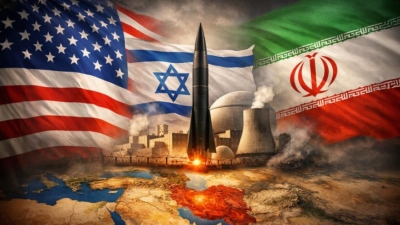
Oil prices are recording a significant rise, while transport costs are surging, as concern intensifies over the security of sea lanes following the air strikes by the United States and Israel on Iran and Tehran’s retaliation.
The new escalation in the Middle East is reigniting fears of a new wave of inflation, at a time when markets are trying to assess the consequences for interest rates and global growth.
How much will the oil “fever” affect inflation?
Economists point out that rising oil prices have a direct and measurable impact on inflation.
Capital Economics estimates that a 5% annual increase in oil prices adds on average about 0.1 percentage points to inflation in major economies.
In this context, a rise in prices to $100 per barrel could increase global inflation by 0.6 to 0.7 percentage points.
A 2017 study by the International Monetary Fund (IMF), which examined the period 1970 to 2015, showed that a 10% increase in global oil costs adds on average 0.4 percentage points to domestic inflation.
These developments also directly affect borrowing costs.
In Britain, markets now estimate that the chances of an immediate interest rate cut by the Bank of England are decreasing.
The probability of a cut to 3.5% now stands at 68%, compared to 75% before markets opened. A second cut is expected in July.
Can Iran close the Strait of Hormuz?
Analysts note that Iran has multiple means to attempt a blockade of the Strait of Hormuz.
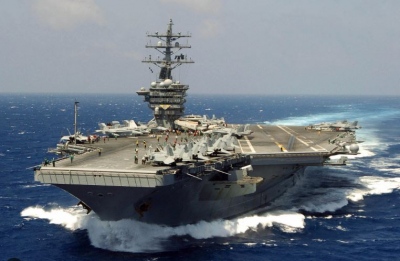
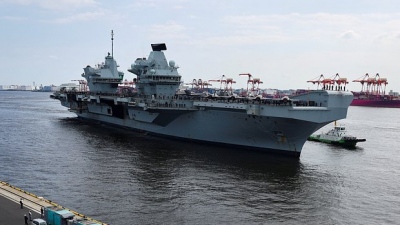
Nick Childs, a naval security expert at the International Institute for Strategic Studies, notes that the country has developed a “significant arsenal,” including mine-laying capabilities, fast attack craft, submarines, drones and missile systems.
“If used in a coordinated campaign, they can cause extremely serious disruption and endanger American and other naval units, even minesweeping vessels,” he stresses.
There is also the possibility that Iran may not fully close the passage, but instead proceed with targeted harassment of specific vessels, possibly Israeli, American or Western interests.
However, a complete halt to transit would constitute an extreme step, as it would also hit key trading partners of Iran, such as China, as well as Qatar and the United Arab Emirates.
“Seismic” consequences for the global economy
Ed Conway, economics and data analyst, warns that the consequences could be “seismic.”
Although the initial market reaction appears restrained, this does not guarantee limited long-term effects.
“Many expected an even greater immediate shock,” he notes, stressing however that the real question concerns the deeper repercussions.
Shipping companies operating in the Strait of Hormuz are waiting to see whether they will be able to continue transits, while serious questions are also being raised about insurance costs.
“In the short term, this means higher inflation: more expensive oil, more expensive transport and, ultimately, increases in fuel prices,” Conway points out.
At the same time, he highlights secondary effects.
Dubai, the United Arab Emirates and Qatar now play a pivotal role in the global economy.
If passengers begin avoiding flights via the United Arab Emirates, with Dubai being one of the largest airports worldwide, the impact on the flow of people and goods will be wide-ranging.
“We are on the first trading day after potentially seismic events, not only for energy but for the entire global economy,” he emphasizes.
“Collapse” in oil tanker transit
Although Iran produces only 3% of global oil supply, according to the International Energy Agency (IEA), its control over the Strait of Hormuz gives it enormous geo-economic power.
Analytics firm Kpler reports that tanker departures from the eastern part of the Strait “collapsed” to just three vessels yesterday, compared to 10 to 11 daily in the previous period.
According to Kpler, attacks near the mouth of the Gulf, the rapid repricing of war risk insurance premiums and the cancellation of insurance coverage contributed decisively.
Even if the Strait remains open, waiting for stabilization of the situation and route changes will slow deliveries and increase costs.
Can oil exceed $100?
Paolo Zanghieri of Generali Investments estimates that the United States–Israel conflict with Iran may last longer than the corresponding crisis of summer 2025.
A complete halt to navigation in the Strait of Hormuz could remove 15 to 20% of global production.
Although OPEC+ increased output by 206,000 barrels per day and spare capacity is available, the key remains the reopening of the passage.
A partial disruption due to “sporadic attacks” or mine-laying could push prices to $90 or higher. Strikes on Gulf oil facilities would drive prices even higher, but would damage Iran’s already fragile relations with China.
Why is the Strait of Hormuz so critical?
The Middle East is the world’s leading oil-producing region and a key maritime trade hub.
Approximately one fifth of global oil trade passes through the Strait of Hormuz.
The narrow maritime passage, just 33 kilometers wide at its narrowest point, lies in the territorial waters of Iran and Oman and leads into the Gulf of Oman, opening the route to international markets.
Analysts at Goldman Sachs have warned that a blockade of the passage could push oil prices above $100 per barrel.
However, such a move would be extremely risky for Iran, as it would hit key partners such as China, as well as other oil-producing states in the region.
www.bankingnews.gr






Σχόλια αναγνωστών